
The Smart Way to Calculate Your Needs After 40
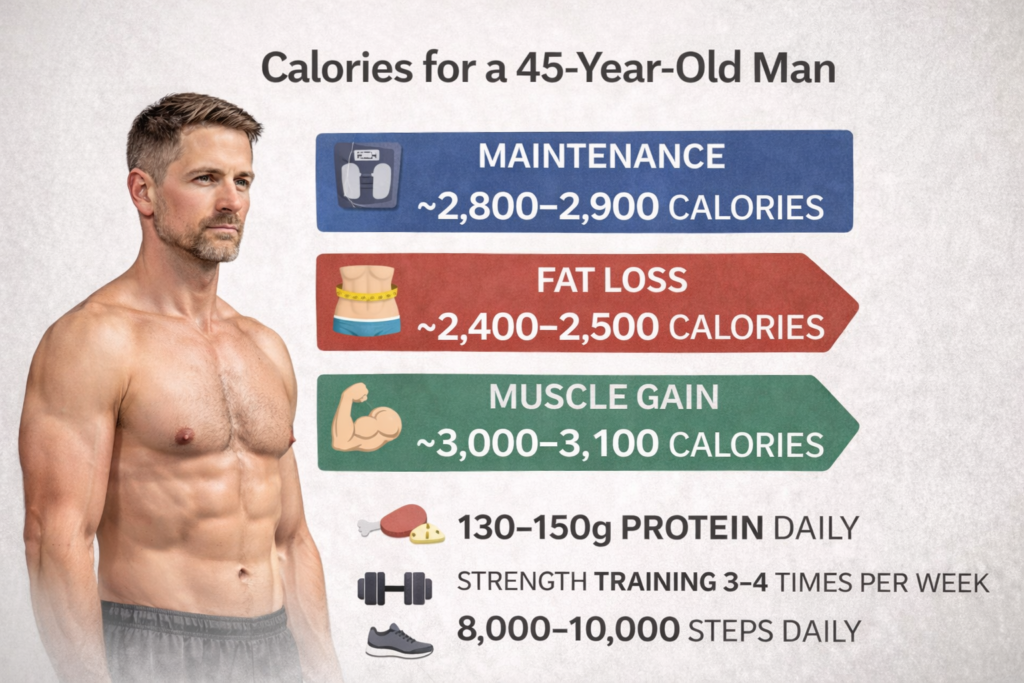
At 25, you could eat like a college linebacker and still see your abs.
At 45?
You look at a slice of pizza and your belt tightens.
Welcome to metabolic reality.
But here’s the truth:
Your metabolism isn’t broken.
It’s just different.
The real question is not:
“How do I eat less?”
It’s:
“How many calories do I actually need now?”
Let’s break it down clearly and practically.
Step 1: Understand What Changes After 40
Several things shift:
- Muscle mass gradually declines
- Testosterone slowly decreases
- Daily movement often drops
- Recovery slows
- Stress increases
Muscle is metabolically active tissue.
Less muscle = fewer calories burned at rest.
But this isn’t doom.
It just means we calculate intentionally.
Step 2: Calculate Your Baseline (Maintenance Calories)
The easiest practical formula:
Bodyweight (lbs) × 14–16
Use:
×14 if sedentary
×15 if moderately active
×16 if very active
Example:
If you weigh 190 lbs and train 3–4 times per week:
190 × 15 = 2,850 calories per day (approximate maintenance)
That means:
Around 2,850 calories keeps your weight stable.
Simple. Practical. Effective.
Step 3: Adjust Based on Your Goal
Now we personalize.
If You Want to Lose Fat
Subtract 300–500 calories.
Using our 190 lb example:
2,850 – 400 = ~2,450 calories per day
This creates a sustainable fat loss pace of:
0.5–1 pound per week.
Not dramatic.
Not flashy.
But sustainable and muscle-friendly.
If You Want to Maintain
Stay around maintenance.
Focus on:
- Strength training
- Protein intake
- Recovery
Maintenance is underrated.
Stability builds longevity.
If You Want to Build Muscle
Add 200–300 calories above maintenance.
Using the same example:
2,850 + 250 = ~3,100 calories
Slow surplus.
Controlled gains.
Minimal fat accumulation.
After 40, bulk like a strategist.
Not a teenager.
Step 4: Prioritize Protein
Calories matter.
But composition matters more.
After 40:
Protein target = 0.7–0.8g per pound of bodyweight.
For 190 lbs:
130–150g protein daily.
Why?
Protein:
- Preserves muscle
- Improves satiety
- Supports testosterone
- Aids recovery
If calories are right but protein is low, you lose muscle.
And muscle loss slows metabolism further.
We avoid that trap.
Step 5: Balance Fats and Carbs
Once protein is set:
Fats: 25–35% of total calories
Carbs: Fill the remainder
Don’t go extreme.
Very low-fat diets can impact hormones.
Very low-carb diets can reduce training performance.
Balance supports sustainability.
Step 6: Consider Activity Level Honestly
Many 45-year-old men overestimate activity.
Office job + 3 workouts per week ≠ athlete.
Track steps.
8,000–10,000 per day is a strong baseline.
If steps are low, calorie needs are lower.
Movement increases metabolic flexibility.
Why Calorie Needs Feel Lower Now
Common reasons:
- Less spontaneous movement
- More sitting
- Less muscle
- More stress eating
- Poor sleep
Sleep alone can influence hunger hormones significantly.
If sleep is under 6 hours consistently, appetite increases naturally.
Sometimes it’s not metabolism.
It’s fatigue.
Signs You’re Eating Too Much
- Waistline increasing
- Energy sluggish after meals
- Strength not improving
- Constant bloating
Signs You’re Eating Too Little
- Strength dropping
- Constant fatigue
- Poor sleep
- Irritability
- Low libido
After 40, under-eating can harm hormones.
Balance is power.
How to Track Without Obsession
You don’t need lifelong calorie counting.
Use tracking for 2–4 weeks to understand:
- Portion sizes
- Protein intake
- Snacking patterns
Then adjust intuitively.
Awareness creates control.
The Bigger Picture
Calories are not the enemy.
They are fuel.
The real goal is:
- Maintain muscle
- Reduce excess fat
- Support hormones
- Stay strong long-term
You are not dieting for beach photos.
You are fueling a 20-year runway.
Quick Reference Guide
Example: 45-Year-Old Man, 190 lbs
Maintenance: ~2,800–2,900 calories
Fat loss: ~2,400–2,500 calories
Muscle gain: ~3,000–3,100 calories
Protein: 130–150g daily
Strength training: 3–4 times per week
Steps: 8–10k daily
The Real Strategy After 40
Stop guessing.
Calculate once.
Adjust intelligently.
Stay consistent.
Most men don’t need a metabolism reset.
They need clarity.
Strength. Health. Legacy.
https://shorturl.fm/fUfW9
https://shorturl.fm/8l289
https://shorturl.fm/41mUw